


 |
 |
 |
 |
|
 |
 |
28
Hereditary Genius
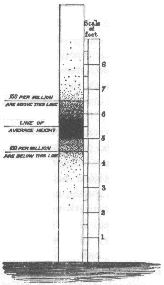
average, that the lower half of the diagram will be almost a precise
reflection of the upper. Next, let a hundred dots be counted from above
downwards, and let a line be drawn below
them. According to the conditions, this line
will stand at the height of seventy-eight
inches. Using the data afforded by these two
lines, it is possible, by the help of the law of
deviation from an average, to reproduce, with
extraordinary closeness, the entire system of
dots on the board.
M. Quetelet gives tables in which the
uppermost line, instead of cutting off 100 in a
million, cuts off only one in a million. He
divides the intervals between that line and the
line of average, into eighty equal divisions,
and gives the number of dots that fall within
each of those divisions. It is easy, by the help
of his tables, to calculate what would occur
under any other system of classification we pleased to adopt.
This law of deviation from an average is perfectly general in its
application. Thus, if the marks had been made by bullets fired at a
horizontal line stretched in front of the target, they would have been
distributed according to the same law. Wherever there is a large number of
similar events, each due to the resultant influences of the same variable
conditions, two effects will follow. First, the average value of those events
will be constant; and,
 |
|
 |
|